The free GP calculator for accurate menu pricing
General information for UK hospitality operators, not legal advice. If something here is wrong or out of date, the editorial policy explains how to report it.
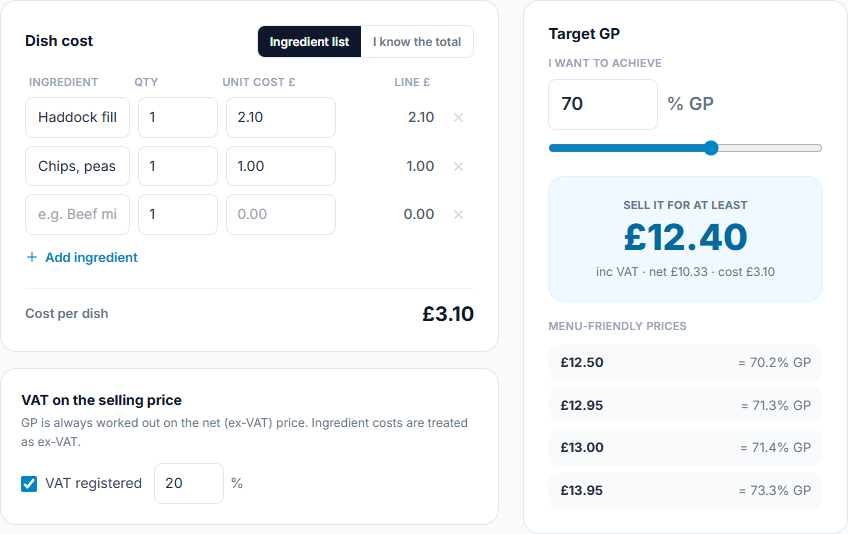
A GP calculator works out true dish and drink margins on the price left after VAT, in about a minute per item, then blends the whole menu.
A GP calculator turns an ingredient cost and a selling price into a gross profit percentage, and it does that sum on the price left after VAT has been taken off, not on the figure printed on the menu. For a VAT-registered business charging the standard rate of 20 percent, a £12 dish is a £10 sale, so gross profit has to be measured against the £10 or the plate looks more profitable than it is. The same arithmetic covers a pint drawn from a keg and, once every dish is costed, the blended margin of the whole menu.
Why a GP calculator strips VAT out of the selling price
Gross profit is the difference between what an item costs to produce and what it earns net of VAT, expressed as a percentage of that net figure. The VAT collected on a sale never belongs to the business; it is held for HMRC, so treating it as revenue inflates every margin on the board. The standard rate of VAT is 20 percent, which means dividing a menu price by 1.2 to reach the net sale. On a £20 main the difference between the gross and net figures is £3.33, and repeated across every line on a busy Saturday that is the gap between a food GP that is genuinely healthy and one that only looks healthy on a whiteboard behind the pass.
Not every hospitality sale carries the standard rate. HMRC treats supplies made in the course of catering, which covers eat-in food and hot takeaway food, as standard-rated, while cold food sold to take away can be zero-rated, subject to the items that are standard-rated wherever they are sold. A counter operation can therefore run two different net figures behind one price list, and a costing is only right if it follows the rate that applies to that sale. A business that is not VAT-registered charges no VAT at all, and its menu price and its net price are the same number. Either way the working needs to survive being asked about later: VAT records must be kept for six years, and HMRC sets out what that covers in its guidance on keeping VAT records.
Pricing a dish against a target margin
Costing a plate is the easy half. Take a fish and chips dish at £3.10 of ingredients, set a target of 70 percent, and the net price needed is £10.33, which is £12.40 on the menu once VAT at the standard rate is added back. From there a manager can round to a price that sits comfortably with the rest of the board and read off the margin each rounded price actually delivers, rather than picking a number that ends in an awkward run of pence. Zynthio's free GP calculator does this maths in the browser for a single dish or a keg without an account, so the sum happens before a price goes on the menu rather than being reverse-engineered from the accounts months later.
The reason to do it this way round is that a target margin is a decision and a price is a consequence. Pricing first and calculating afterwards tends to produce a board where the margin is whatever it happened to be, and where nobody can say which dishes are carrying the others. Setting the target first also makes a supplier increase easy to answer, because the only question is what the new ingredient cost does to the price needed to hold the same margin.
Kegs, casks and glasses: wet GP needs its own arithmetic
Wet GP has a trap that dry GP does not: the buying unit and the selling unit are different sizes, and an allowance for line cleaning, fobbing and spillage sits between the two. A keg or cask does not deliver its full nominal volume in sellable pints, and pricing a pint on the nominal figure alone overstates the margin before anything has been poured. Working from the standard container conversions keeps the arithmetic straightforward, and having them side by side is often the fastest way to spot which line is quietly running behind the others.
| Container | Nominal volume | Standard serve | Full-volume unit count |
|---|---|---|---|
| 50-litre keg | 50 litres | pint (568ml) | 88 pints |
| 9-gallon cask | 40.9 litres | pint (568ml) | 72 pints |
| 750ml bottle | 750ml | 175ml glass | 4 glasses |
| 70cl bottle | 700ml | 25ml measure | 28 measures |
Once a working wastage allowance is taken off that full-volume count, there is a genuine sellable-unit figure to divide the buying cost by, and the resulting cost per pint or per measure feeds the same target-margin logic used for food. The same approach handles wine by the glass and spirits by the measure: pick the container, pick the serve, then deduct the wastage, whether that is a modest allowance on a well-maintained keg line or a larger one on a cask prone to fobbing in warm weather. There is no legal figure for that deduction, so it is worth checking the assumption against what the lines actually pour. Getting the step right matters more than it looks, because a cellar with dozens of lines can hide a steady margin loss across the whole bar without a single obviously wrong price on the list.
Blended GP: what the whole menu actually earns
A dish priced at 75 percent tells a manager very little if it is the slowest seller on the board. A whole-menu view takes every dish with its cost, its price and roughly how many sell in a week, and produces a blended margin weighted by what customers order, plus a projected weekly gross profit figure. That is the number a bank balance experiences, and it is usually lower than the simple average of the individual dish margins, because the best sellers tend to be priced closer to the market than the specials nobody chooses. A burger on a thin margin that sells forty covers a night moves the blended figure far more than a high-margin side dish that sells four times a week, and a menu built without checking the weighting can end up carried entirely by items that are not, in practice, what most tables order. Tracking this alongside weekly stock counts closes the loop between what a menu should earn on paper and what it earned this week, because a count surfaces portioning drift, waste and theft that a pricing calculation on its own cannot see.
Where the cost figures actually come from
A GP calculation is only as accurate as the ingredient costs typed into it, and those costs move with every delivery. Butter, oil and fish prices in particular can shift within a quarter, and a dish costed accurately in January can drift below its stated margin by autumn if nobody revisits the figures feeding it. This is where otherwise careful pricing quietly falls apart: the calculation was right on the day it was done, but no routine existed for checking it again after the next three or four increases came through on invoices. Keeping ingredient costs current, alongside supplier invoices and wastage, is properly the job of stock management that ties counts, deliveries and recipe costs together, rather than a calculation redone from memory whenever someone happens to notice that a margin looks thin. Reviewing food waste and stock control at the same time tends to catch the same leaks from both directions, since a dish that looks correctly priced on paper can still lose money through over-portioning or spoilage that never reaches a cost sheet.
Pricing mistakes that erode margin quietly
Copying the price on the menu down the road is the most common shortcut and the least reliable one, because it says nothing about that venue's costs, portion sizes, rent or staffing; two venues can charge the same price for what looks like the same dish and be several points apart on margin. Failing to reprice after a supplier increase is the second: a dish costed accurately when it was written can be several pence worse by the time it has been on the menu a year, and several pence a plate across hundreds of covers a week is a meaningful drop in weekly gross profit. Running promotions off the original menu price, rather than recalculating the margin on the discounted price, is the third, and it is easy to miss because a discount looks like a marketing decision rather than a pricing one, particularly on set menus and two-for-one offers where the arithmetic is done once and never revisited. None of these is hard to fix once the cost and the VAT treatment are right; the discipline lies in repeating the check every time a price, a recipe or a supplier changes, not only when the menu is reprinted.
Keeping this on the record
Pricing decisions sit alongside the ingredient costs, supplier invoices and VAT figures a business has to be able to produce for the six years HMRC requires. Zynthio's stock management tools keep ingredient costs, supplier prices and stock counts in one place, and recost every recipe that uses an ingredient when its price changes, so the numbers behind a margin match what actually went into the kitchen and across the bar rather than a figure copied from memory.
Frequently asked questions
How does a GP calculator handle VAT?
It works everything out on the net selling price rather than the price printed on the menu. A £12 dish sold by a business registered for VAT at the standard rate of 20 percent is really a £10 sale once the VAT due to HMRC is taken off, and gross profit has to be measured against that smaller figure or every dish will look better than it is.
What wastage allowance should a venue use for a keg or cask?
There is no single legal figure, so most operators build in a working allowance for line cleaning, fobbing and spillage before dividing the buying cost across the sellable pints. The right percentage depends on the line setup and how often it is cleaned, so it is worth checking the assumption against actual pours rather than trusting a fixed number for ever.
Is dish-level GP enough to price a whole menu?
No. A dish priced at 75 percent that nobody orders does not make a 75 percent menu. A blended, whole-menu figure weighted by how many of each dish actually sell gives a far more realistic picture of what the till, and the bank balance, will experience over a week.
How often should ingredient and drink costs be updated?
Whenever a supplier price changes, which in practice means costing against recent invoices rather than a price list from last year. Dishes costed accurately in January can drift below their stated margin by autumn if nobody revisits the ingredient prices feeding the calculation.
Does a GP calculator need an account?
Not for a quick check. A gross profit calculation for a single dish, a keg or a measure can be done in the browser without signing up, which keeps the sum in reach at the moment a price is being decided rather than afterwards.